


Newsroom

Innovative Lithium Extraction Technology Set to Boost U.S. Production
China currently leads the global lithium supply chain, accounting for approximately 65% of battery-grade lithium processing. Recent fluctuations in export restrictions on lithium-based products have raised concerns about economic implications.
In contrast, the United States boasts substantial lithium reserves, particularly in vast underground brines located in southern Arkansas and eastern Texas. However, traditional extraction methods are often energy-intensive and pose environmental challenges, raising questions about their economic viability.
Enter Lithios, a startup founded by Mo Alkhadra and Martin Z. Bazant, which is pioneering an innovative lithium recovery method known as Advanced Lithium Extraction. This cutting-edge process utilizes electrical energy to facilitate reactions with electrode materials, effectively extracting lithium from saline brine while discarding other impurities.
Lithios claims that its method is more selective and efficient compared to other direct lithium extraction techniques currently under development. Notably, it presents a cleaner and less energy-demanding alternative to conventional mining and solar evaporation methods typically employed in South American deserts.
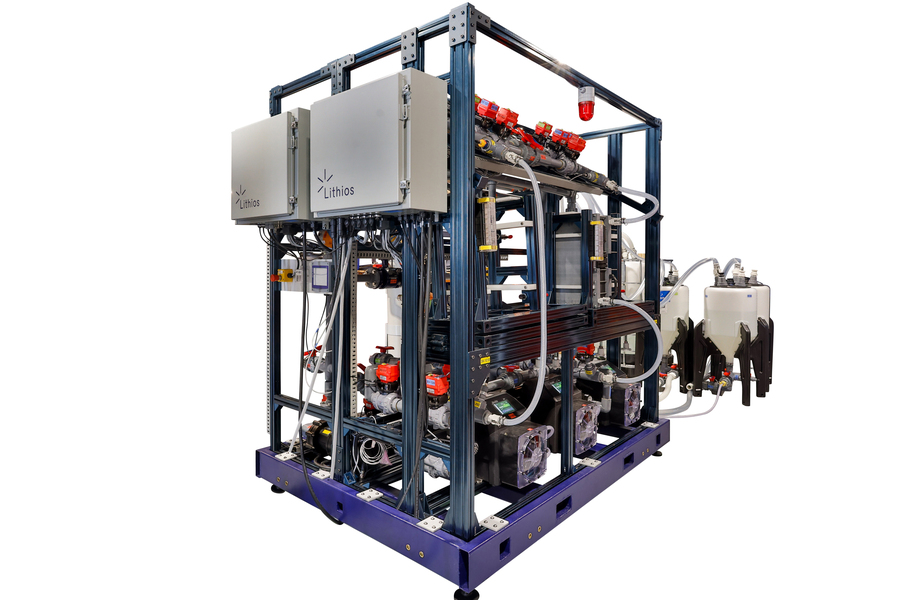
Since June, Lithios has been successfully operating a pilot system that extracts lithium from brine sources globally. Recently, the company also delivered an early version of its extraction system to a commercial partner in Arkansas to enhance operational capabilities.
With its core technology validated, Lithios aims to launch a larger-scale operation next year, capable of producing between 10 and 100 tons of lithium carbonate annually. The long-term vision includes the establishment of a commercial facility with a production capacity of 25,000 tons per year, significantly boosting U.S. lithium output, which currently stands at less than 5,000 tons.
“There has been a strong movement recently to secure domestic lithium supplies and reduce dependence on China’s critical mineral supply chain,” says Alkhadra. “The U.S. possesses rich lithium deposits, but we need the right technology to unlock their potential.”
Bazant recognized the urgent need for innovative lithium extraction methods during his collaborations with battery manufacturers at MIT’s Chemical Engineering Department. His research group has a long history of studying battery materials and electrochemical separation processes.
As part of his doctoral research under Bazant’s mentorship, Alkhadra focused on electrochemical techniques for separating dissolved metals, particularly targeting lead removal from drinking water and industrial wastewater treatment. As he approached graduation, Alkhadra and Bazant identified promising commercial applications for his research.
In 2021, amid a historic surge in lithium prices fueled by the metal’s critical role in battery technology, the need for effective extraction became even more apparent.
Lithium is predominantly sourced through mining or through slow evaporation processes that require extensive surface ponds for refining. Both methods are energy-intensive and environmentally detrimental, with Chinese companies dominating these supply chains.
“A significant amount of hard rock mining occurs in Australia, but most of the raw material is shipped to China for processing due to their advanced technology,” Bazant explains.
While other direct lithium extraction methods rely on chemicals and filters, Lithios’ founders argue these techniques often fail to be economically viable given the low lithium concentrations and high impurity levels in U.S. reserves.
“These methods can be effective with high-quality lithium brines but become increasingly impractical as the resource quality declines — a challenge currently faced by the industry,” Alkhadra notes. “The traditional evaporative process requires extensive land use — comparable to the area of Manhattan for a single project. My doctoral research at MIT focused on recovering minerals from lower-concentration sources, which we adapted for this application.”
During initial discussions with prospective clients, Alkhadra received support from MIT’s Venture Mentoring Service, the MIT Sandbox Innovation Fund, and the Massachusetts Clean Energy Center. Lithios was officially established after Alkhadra completed his PhD in 2022 and secured the Activate Fellowship.
The company initially operated at The Engine, an MIT startup incubator, before relocating to their pilot and manufacturing facility in Medford, Massachusetts in 2024.
Lithios employs a proprietary electrode material that selectively attaches to lithium when subjected to precise electrical voltages. “Imagine a large battery with brine flowing into the system,” Alkhadra describes. “When the brine interacts with our electrodes, it efficiently captures lithium while discarding contaminants. Once lithium is absorbed onto our materials, we can reverse the electrical current to release it back into a clean water stream — akin to charging and discharging a battery.”
Bazant highlights that the company’s lithium-absorbing materials are particularly well-suited for this application: “One of the main challenges in utilizing battery electrodes for lithium extraction is system integration. We have developed a robust lithium-extraction material that remains stable in water and performs exceptionally well. Our research has also focused on optimizing electrode formulation for efficient ion transport and mixing, driving down costs.”
According to a recent U.S. geological survey, the Smackover Formation in Arkansas alone contains between 5 to 19 million tons of lithium.
“Estimating the value of lithium in this region at current prices suggests around $2 trillion worth of untapped resources,” Bazant asserts. “Efficient extraction could significantly impact local and national economies.”
Earlier this year, Lithios deployed its pilot system with a commercial partner in Arkansas to further validate its methodology. Plans are underway for several additional pilot projects with major partners in the oil, gas, and mining sectors over the next few years.
“Following this field deployment, Lithios is set to rapidly progress towards a commercial demonstration plant by 2027, with aspirations for scaling up to a kiloton-per-year facility by the end of the decade,” Alkhadra indicates.
While Lithios is currently focused on lithium extraction, Bazant notes that their innovative approach could be adapted for other critical materials such as rare earth elements and transition metals in the future.
“We are developing a pioneering technology that could position the U.S. as a leader in critical mineral separation — an endeavor that would not have been possible without MIT’s unique environment,” Bazant concludes. “The MIT ecosystem is filled with exceptional scientists and business professionals who are technically adept and eager to engage in transformative projects like this one. Our first team members were MIT graduates who truly embodied the innovative spirit of our company.”
