



Newsroom

Exploring Climate Change Impacts on Hawaii’s Forests and Biodiversity
Hawaiian ecosystems are at a critical crossroads, where climate change, invasive species, and environmental shifts converge to threaten unique native forests and biodiversity. Field research at MIT offers invaluable insights into these complex interactions and their impact on forest health and atmospheric chemistry.
Exploring Climate Change Effects on Hawaiian Forests
During a two-week visit to her home state of Hawaii as part of the MIT class 1.091 (Traveling Research Environmental eXperiences), Joy Domingo-Kameenui was taken aback by the number of invasive and endangered species present. “I had some knowledge of Hawaiian ecology from my school days, but I wasn’t fully aware of the extent to which invasive species and diseases have put many of Hawaii’s unique species at risk,” Domingo-Kameenui remarked.
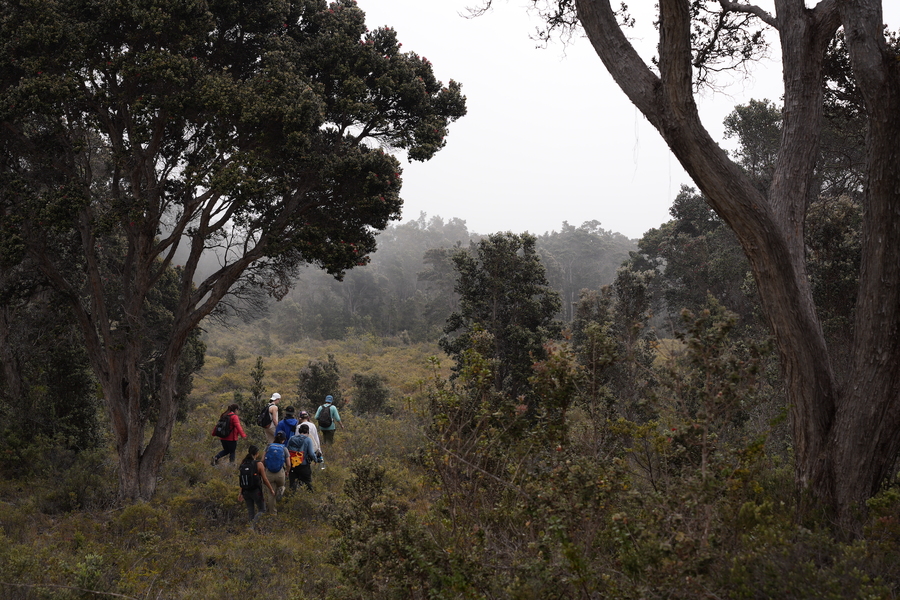
Domingo-Kameenui was among a group of MIT students engaged in field research on the Big Island of Hawaii through the TREX course offered by the Department of Civil and Environmental Engineering. This program equips undergraduates with hands-on experience in environmental fieldwork, utilizing Hawaii’s diverse geology, chemistry, and biology to tackle pressing climate change issues, specifically focusing on sulfur dioxide (SO2) emissions and forest health.
Hawaiian Forests as a Model for Climate Impact Studies
David Des Marais, the Cecil and Ida Green Career Development Professor of Civil and Environmental Engineering and TREX’s lead instructor, noted, “Hawaii serves as an excellent system for investigating climate change effects. Historically, the islands experienced occasional mild droughts linked to El Niño; however, these droughts are becoming increasingly severe and frequent, mirroring global trends in extreme weather events.”
The impact of climate change on forests is profound, with rising frequency and intensity of extreme weather posing significant challenges for vegetation. Forests exhibit a distinct pattern of vegetation distribution; as elevation increases, trees transition into shrubs and ultimately rock formations. Unlike mountain ranges such as the Sierra Nevada or Rockies, where trees gradually adapt to higher altitudes, Hawaiian forests reach a point where tree growth ceases altogether, according to Des Marais.
“This characteristic makes Hawaii a compelling model for studying climate change,” Des Marais explained. “The altitude at which trees cease to grow will shift due to changing global air circulation patterns influenced by climate change, leading to increased instability.”
Innovative Fieldwork Techniques in Forest Health Assessment
Students were challenged to explore how climate change might affect Hawaiian forests. Their research involved trekking up mountains to collect ground-level canopy cover data using smartphone apps, assessing tree coverage from below, and observing the thinning canopy until they reached tree-less areas. Drones were deployed above the forest canopy to measure chlorophyll levels and assess remaining plant biomass. Satellite data from NASA and the European Space Agency was also utilized to analyze chlorophyll distribution alongside climate and precipitation metrics.
Additionally, students collaborated with community stakeholders at three locations across the island to evaluate forest ecosystems and biodiversity challenges using advanced technology. One such partner was the Kamehameha Schools Natural and Cultural Ecosystems Division, dedicated to sustainable land management. Students worked closely with plant biologists to strategize future forest health management practices.
“Hawaiian forests face unprecedented threats from climate shifts and invasive species, demanding innovative research and community collaboration to preserve their unique biodiversity.”
Invasive Species and Their Impact on Native Ecosystems
Hawaii’s forests also face critical threats from invasive species. Non-native mosquitoes contribute to increased avian malaria rates, resulting in native bird fatalities that jeopardize the ecosystem. Another concerning invasive species is strawberry guava, which is encroaching upon Hawaii’s native ōhiʻa trees. Domingo-Kameenui noted its impact on Hawaii’s water supply, stating that these plants rapidly absorb water, reducing runoff into groundwater systems.
Moreover, a fungal pathogen is endangering native ōhiʻa trees through a disease known as rapid ʻohiʻa death (ROD). This deadly pathogen was first identified by researchers in 2014 and is believed to have been introduced by human activities such as footwear and contaminated tools. The disease can also spread via beetles that bore into trees, creating fine dust that can disperse fungal spores across vast areas.
“Witnessing the effects of ROD in the field underscored the significance of proper care and preventive measures for native forests,” Gillikin remarked. “The ‘ohi’a tree is one of Hawaii’s most vital native species, and ROD can swiftly devastate them by stressing their vascular systems and inhibiting water transport throughout the tree.”
Prior to entering forested areas, students routinely sprayed their footwear and equipment with ethanol to mitigate the risk of spreading pathogens.
Investigating Volcanic Smog (Vog) and Atmospheric Chemistry
A separate research initiative within TREX focused on volcanic smog (vog), which affects air quality and poses health risks for residents. The active Kilauea volcano emits SO2 into the atmosphere; when combined with other volcanic gases and sunlight, this results in particulate matter formation.
Under the guidance of Jesse Kroll, a professor specializing in civil and chemical engineering, students from the Kroll Group have been investigating SO2 and particulate matter dynamics for years. However, they sought to directly examine the chemical transformations involved in this process.
“There has long been a hypothesis suggesting a functional relationship between SO2 and particulate matter, but it had never been conclusively demonstrated,” said Des Marais.
To test this hypothesis, students measured two different sizes of particulate matter generated from SO2 emissions and developed a model to quantify how much vog is produced downstream from the volcano.
They spent five days at two locations measuring particulate formation from sunrise until late morning, capturing data as sunlight began influencing new particle development. By integrating various meteorological data—such as UV index, wind speed, and humidity—students crafted a model that outlines all variables contributing to particle formation.
“While you can theorize an equation based on your understanding of chemical composition, these students conducted real-time measurements with actual chemical reagents,” Des Marais explained.
The team analyzed factors that catalyze particulate reactions—such as sunlight and ozone—and calculated outcomes based on their findings.
“Their results indicate that chemical reagents accumulate overnight,” Des Marais added. “When sunlight rises, rapid transformations occur in the atmosphere. Many reagents are depleted quickly by the sun’s energy, causing polluted air to drift across the island.”
Reflections on Fieldwork and Community Engagement
“Participating in the vog particle formation fieldwork was an eye-opening experience for me,” Domingo-Kameenui shared. “I had assumed particle formation was solely an airborne process; however, we discovered that wind direction and speed at specific times significantly influence particle creation. It’s crucial to consider not just chemistry but also meteorology and sunlight conditions.”
Both Domingo-Kameenui and Gillikin found their fieldwork experience invaluable, offering insights that extend beyond their time at MIT.
“What I will cherish most about engaging in fieldwork or community interactions in different cultures is recognizing that being on their land provides an opportunity to learn about their history and connect with remarkable individuals,” Gillikin reflected. “Everyone we met in Hawaii showed immense passion for their work; approaching these environments with respect and a willingness to learn has made a lasting impression on me that I will carry throughout my career.”
