



Newsroom

Exploring Metalloenzymes: Bridging Science and Art for Enhanced Reactivity Insights
As the scenic landscapes of California’s Napa Valley roll by, young David Kastner engages in thought-provoking discussions with his father, transitioning seamlessly from topics like gravity to electromagnetism. This spark of scientific curiosity has always been a pivotal aspect of their conversations during these drives.
The Journey of a Young Scientist
Now a fourth-year PhD student specializing in biological engineering at MIT, Kastner reflects on his early fascination with the complexities of the universe and the quest for new truths. His research focuses on a challenging category of proteins known as metalloenzymes, under the guidance of esteemed professors in chemical and biological engineering.
Kastner’s work is driven by a desire to unlock the chemical and medical potential of enzymes using advanced computational and mechanistic approaches. By employing cutting-edge computational methods, he aims to reveal the fundamental blueprints governing enzyme reactivity.
Blending Science and Art
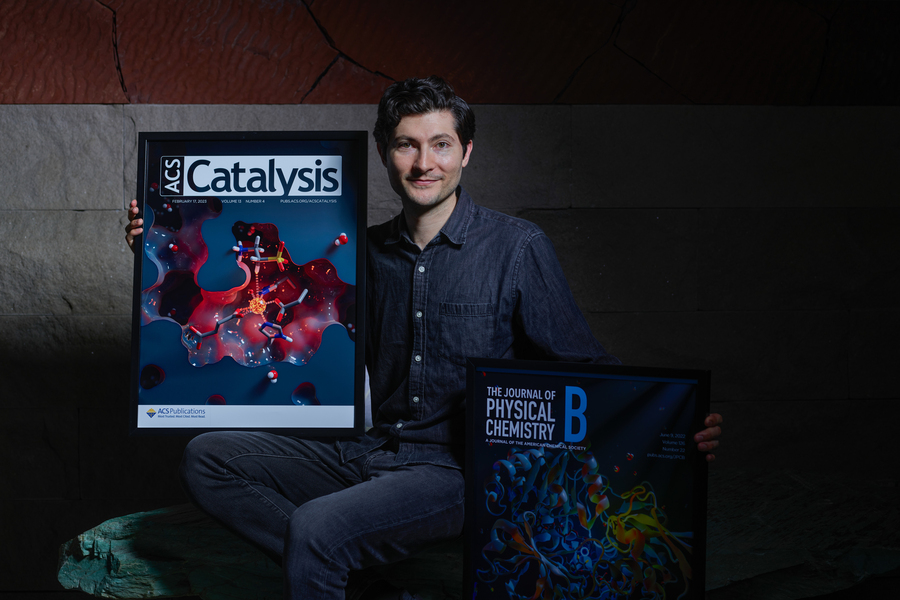
What sets Kastner apart is his unique blend of scientific inquiry and artistic expression. He creates stunning 3D illustrations of molecular systems, making his research more accessible to a broader audience. “Visualizing science in an engaging manner can be more impactful than traditional graphs,” he notes, emphasizing the importance of captivating presentations in promoting scientific interest.
Kastner’s academic journey encompasses various disciplines including quantum chemistry, protein engineering, and synthetic organic chemistry. After completing his biophysics degree at Brigham Young University, he honed in on metalloenzymes during his doctoral studies.
Decoding Metalloenzymes’ Reactivity
He has chosen to investigate high-valent metalloenzymes, which contain reactive metal atoms eager to regain lost electrons. Among them, he is particularly intrigued by non-heme iron enzymes due to their extensive range of reactions and their relevance to human health.
However, enhancing the reactivities of these enzymes poses challenges. His initial published work shed light on the mechanistic differences between two classes of high-valent enzymes: non-heme iron halogenases and hydroxylases, which activate typically inert C–H bonds. Through structural database analysis and molecular dynamics simulations, Kastner identified critical interactions that affect substrate positioning and reactivity.
Advanced Computational Approaches
Modeling enzymes becomes increasingly complex when metals are involved. “Adding metal into an enzyme’s core complicates the modeling process, necessitating advanced tools to grasp reactivity,” Kastner explains. Quantum chemistry calculations play a vital role in this aspect of research.
To unravel nature’s most efficient catalysts, researchers must observe at the most precise levels. The structural and reactive characteristics of enzymes stem from electron interactions, underscoring the reliance on quantum computing techniques.
In his latest publication, Kastner and his team discovered that the reactivity of miniature artificial metalloenzymes is influenced by changes in dynamic charge distributions, showcasing how electron fluctuations affect enzyme behavior.
“If you want to understand life, examining enzymes and proteins is essential,” he asserts. “Enzymes represent evolution’s ingenious machinery harnessing physics and chemistry to sustain life.”
Merging Artistic Passion with Science
In addition to his research pursuits, Kastner employs 3D graphics software like Blender and VMD to visualize macromolecular interactions. His artistic contributions have graced the covers of esteemed scientific journals, although his initial artistic endeavors were more straightforward.
“Drawing was my pastime; I would ask everyone around me to create art with me,” he recalls. His mother, an artist inspired by nature, profoundly influenced his artistic journey. A photorealistic piece of a lynx she created captured his imagination as a child.
Kastner took traditional art seriously during high school, winning awards for his charcoal and oil works. However, he struggled to merge this passion with his academic interests until he realized the potential synergy between art and science.
“Historically, figures like Leonardo da Vinci exemplified the integration of various disciplines,” he reflects. “Da Vinci’s dual legacy as a pioneering scientist and artist inspires me to bridge these worlds today.”
Communicating Science Through Art
Kastner believes that enhancing public trust in science could stem from clearer communication. Scientific literature can be dense and technical, often alienating the general public. He advocates for using art as a tool to simplify complex data and engage wider audiences.
“By translating intricate scientific concepts into relatable visuals, we can invite diverse audiences to connect with science through a shared artistic language,” he concludes.
