



Newsroom

Innovative Antibody Delivery System Enhances Patient Convenience and Accessibility

Antibody therapies for cancer and various diseases have traditionally been administered intravenously due to the large volume required for each dose. This often necessitates long hours in a hospital for patients receiving infusions.
Revolutionizing Antibody Delivery
A significant breakthrough by engineers has enabled the reformulation of antibodies, allowing them to be delivered through a standard syringe. Researchers have successfully developed solid particles containing highly concentrated antibodies suspended in a solution. Remarkably, only 2 milliliters of this solution is needed per dose.
This innovation greatly enhances the convenience of antibody treatments, making them more accessible for patients, particularly the elderly or those with mobility challenges who find it difficult to visit hospitals regularly.
“As the global population ages, it is crucial to make treatment processes more user-friendly and accessible for these demographics,” remarks Talia Zheng, a graduate student involved in the research.
Scientific Collaboration and Study Background
The study, published in Advanced Materials, also includes contributions from MIT graduate students and experts in chemical engineering.
Therapeutic antibodies like rituximab are essential in treating various cancers and infectious diseases, as well as autoimmune conditions such as rheumatoid arthritis and multiple sclerosis. Traditionally, these antibodies are diluted in water-based solutions at low concentrations (10 to 30 milligrams per milliliter), requiring a minimum of 100 milliliters per dose—far too large for standard syringe injections.
To facilitate injection, antibody concentrations need to exceed 300 milligrams per milliliter; however, this would result in a solution that is too viscous for safe injection. Previous attempts at developing concentrated formulations involved complex processes like centrifugation, which are not easily scalable.
Innovative Formulation Techniques
In their latest research, the team adopted a novel approach by creating droplets suspended in an emulsion, akin to oil and vinegar. In this method, antibody droplets are suspended in pentanol, an organic solvent.
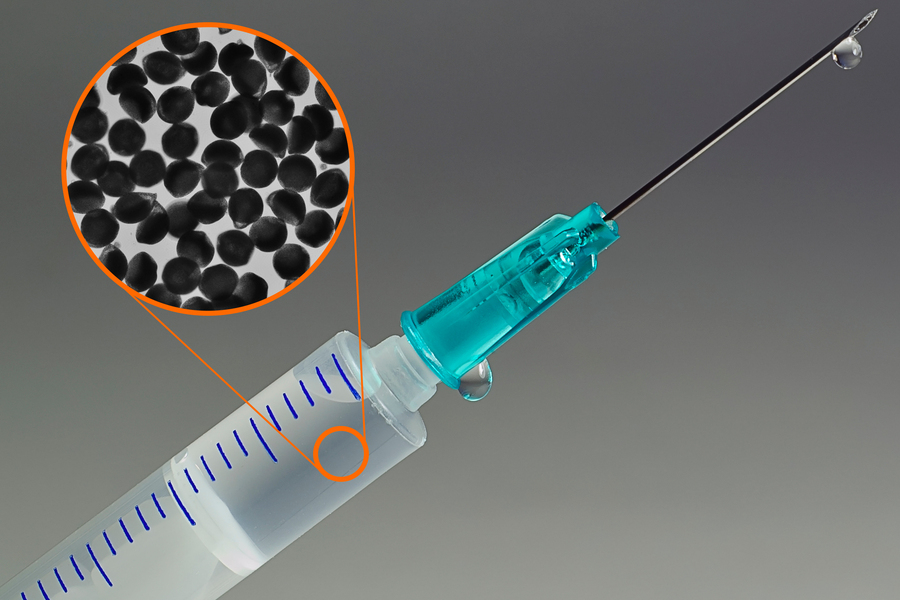
Upon dehydration, these droplets transform into highly concentrated solid antibody particles—approximately 360 milligrams per milliliter—while incorporating a small amount of polyethylene glycol (PEG) to enhance stability.
The surrounding organic solvent is then replaced with an aqueous solution, similar to current therapeutic antibody infusion methods. This process can be executed swiftly using a microfluidic setup without the need for centrifugation, facilitating easier scaling with GMP-compliant emulsification devices.
“Our initial method was quite rudimentary, but with this new approach, we focused on simplicity and scalability,” explains Doyle, a leading researcher on the project.
Performance and Future Prospects
The researchers successfully controlled the particle size between 60 to 200 microns by adjusting the flow rate of the solutions. Testing with 100-micron particles demonstrated that the force required to inject the solution was less than 20 newtons, significantly below the maximum acceptable force.
Using a standard 2-milliliter syringe, over 700 milligrams of target antibodies can be administered at once—sufficient for most therapeutic needs. Stability tests showed that these formulations remain effective under refrigeration for at least four months.
The next steps involve testing these antibody particles in animal models and scaling up production to support large-scale testing. This research was made possible through funding from educational programs and government initiatives.
