



Newsroom

Innovative Microfluidic Chip Revolutionizes CAR T-Cell Production for Cancer Therapy
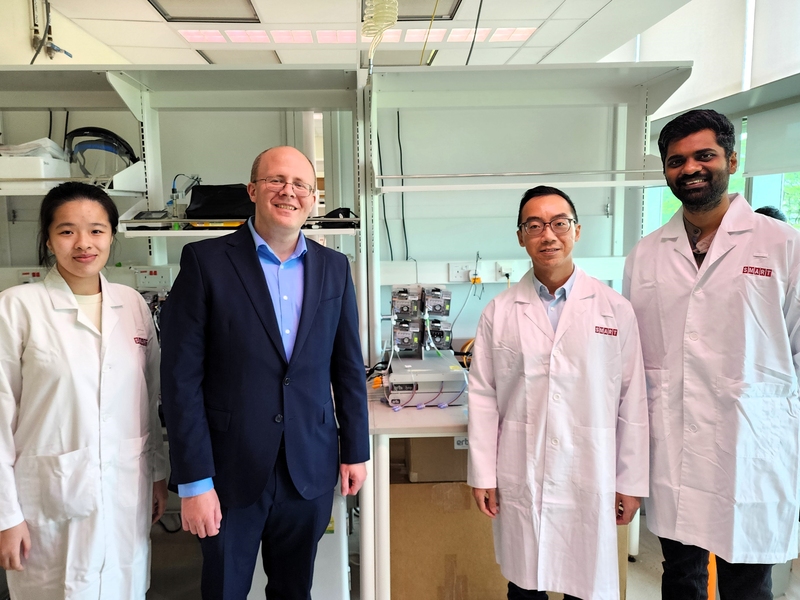
Researchers at the Singapore-MIT Alliance for Research and Technology (SMART) have pioneered an innovative approach to produce clinical doses of viable autologous chimeric antigen receptor (CAR) T-cells using a compact automated closed-system microfluidic chip, roughly the size of a deck of cards.
Innovative Microbioreactor Revolutionizes CAR T-cell Manufacturing
This groundbreaking development marks the first application of a microbioreactor in the manufacturing of autologous cell therapy products. The newly developed method effectively expands CAR-T cells, achieving comparable efficacy to those produced by traditional systems, but with a significantly smaller footprint and reduced resource consumption. This advancement promises to make the scaling-up of autologous cell therapy more efficient and cost-effective, potentially allowing for point-of-care manufacturing of CAR T-cells in settings like hospitals.
CAR T-cell therapy involves isolating, activating, genetically modifying, and expanding a patient’s own T-cells to target tumor cells after reinfusion. While cell therapies have transformed cancer immunotherapy, delivering long-term remissions for some patients, the existing CAR-T cell manufacturing processes remain inconsistent, costly, and time-intensive. These processes are vulnerable to contamination and human error, often requiring impractical seeding cell numbers for smaller-scale production. Such limitations create bottlenecks that hinder the accessibility and affordability of these effective therapies.
High-density Automated Process Achieves Remarkable Cell Expansion
In a publication titled “A high-density microbioreactor process designed for automated point-of-care manufacturing of CAR T cells” in the journal Nature Biomedical Engineering, SMART researchers revealed their findings: human primary T-cells can be activated, transduced, and expanded within a 2-milliliter automated closed-system chip to generate over 60 million CAR T-cells from lymphoma donors and more than 200 million from healthy donors. The CAR T-cells produced with this microbioreactor method exhibit similar effectiveness to those made through conventional means while utilizing fewer resources.
The research was spearheaded by the Critical Analytics for Manufacturing Personalized Medicine (CAMP) team at SMART, with collaboration from experts at Duke-NUS Medical School, the Institute of Molecular and Cell Biology, KK Women’s and Children’s Hospital, and Singapore General Hospital.
“This innovation in cell therapy manufacturing has the potential to provide a point-of-care platform that could significantly increase CAR T-cell production slots, minimizing wait times and reducing costs associated with these living medicines, making cell therapy more accessible to a broader population,” stated Michael Birnbaum, co-lead principal investigator at SMART CAMP and associate professor of biological engineering at MIT.
Efficiency Gains and Clinical Implications
With impressive T-cell expansion rates, similar total T-cell quantities can be achieved in the microbioreactor within a shorter culture period (seven to eight days) compared to gas-permeable culture plates (12 days), potentially shortening production times by 30-40%. The CAR T-cells produced from both methods displayed minimal differences in quality and functionality when tested against leukemia cells in mice.
“This new approach indicates that significant miniaturization of current autologous cell therapy production is attainable, potentially overcoming existing manufacturing limitations for CAR T-cell therapy. This miniaturization could facilitate decentralized point-of-care manufacturing while reducing the necessary ‘good manufacturing practice’ (GMP) footprint—one of the key factors driving production costs,” remarked Wei-Xiang Sin, research scientist at SMART CAMP.
Technical Advantages of the Microbioreactor System
The microbioreactor utilized in this study is a perfusion-based automated system that boasts the smallest footprint per dose, minimal culture volume and seeding cell numbers, alongside the highest achievable cell density and process control. Originally developed at MIT, these microbioreactors have now progressed into commercial use by Millipore Sigma.
The reduced starting cell numbers required for this method leads to lower demands for isolation beads, activation reagents, and lentiviral vectors per production run. Additionally, it requires significantly smaller volumes of medium—at least tenfold less than larger automated systems—due to its compact culture volume. This reduction translates into substantial savings on reagent costs, which could greatly benefit patients, particularly pediatric patients with limited T-cell counts.
Future Directions Toward Decentralized Manufacturing
Looking ahead, SMART CAMP aims to further enhance sampling and analytical systems around the microbioreactor to enable CAR-T production with less labor outside laboratory environments. This could support decentralized bedside manufacturing of CAR T-cells while optimizing process parameters and culture conditions to improve cell yield and quality for future clinical applications.
This research initiative is supported by the National Research Foundation Singapore under its Campus for Research Excellence and Technological Enterprise (CREATE) program.
