



Newsroom

Innovative Microfluidic Chip Revolutionizes CAR T-Cell Production for Cancer Treatment
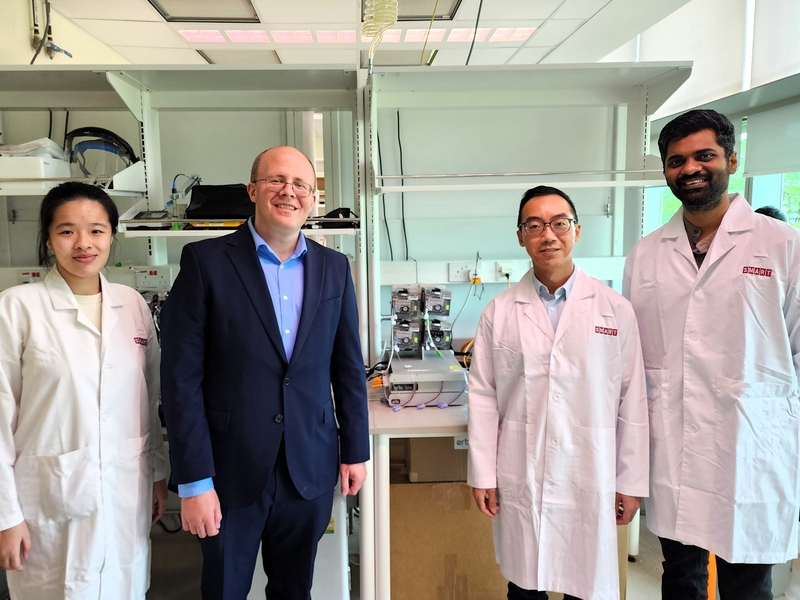
Researchers from the Singapore-MIT Alliance for Research and Technology (SMART) have introduced an innovative approach to produce clinical doses of viable autologous chimeric antigen receptor (CAR) T-cells using a compact, automated closed-system microfluidic chip, roughly the size of a playing card.
Revolutionizing CAR T-cell Manufacturing with Microbioreactors
This groundbreaking method marks the first application of a microbioreactor in the production of autologous cell therapy products. The new technique successfully manufactures and expands CAR-T cells that demonstrate efficacy comparable to those produced via traditional systems, all while occupying significantly less space and utilizing fewer seeding cells and manufacturing reagents. This advancement could pave the way for more efficient and cost-effective scaling of autologous cell therapy production, potentially facilitating point-of-care manufacturing of CAR T-cells in settings like hospitals.
The CAR T-cell therapy process involves isolating, activating, genetically modifying, and expanding a patient’s own T-cells to target and destroy tumor cells upon reinfusion. Although cell therapies have transformed cancer immunotherapy, with some early patients remaining in remission for over a decade, the manufacturing process for CAR-T cells often faces challenges such as inconsistency, high costs, and extended timelines. These issues can lead to contamination risks and human error, hindering the availability and affordability of these effective treatments.
High-Density Automated Production Inside a Compact Chip
In a recent publication in the journal Nature Biomedical Engineering titled “A high-density microbioreactor process designed for automated point-of-care manufacturing of CAR T cells”, SMART researchers outlined their significant findings. They demonstrated that human primary T-cells can be activated, transduced, and expanded to high densities within a 2-milliliter automated closed-system microfluidic chip, producing over 60 million CAR T-cells from lymphoma patients and exceeding 200 million CAR T-cells from healthy donors. The efficiency of CAR T-cells produced through this microbioreactor is comparable to conventional methods but achieved with fewer resources and in a more compact format, potentially lowering manufacturing costs.
This research was led by the Critical Analytics for Manufacturing Personalized-Medicine (CAMP) interdisciplinary group at SMART, with contributions from experts at the Duke-NUS Medical School, the Institute of Molecular and Cell Biology, KK Women’s and Children’s Hospital, and Singapore General Hospital.
“This advancement in cell therapy manufacturing could establish a point-of-care platform that significantly increases CAR T-cell production capabilities, thereby reducing wait times and costs associated with these innovative therapies—making them more accessible to patients.” — Michael Birnbaum, co-lead principal investigator at SMART CAMP
Accelerated Culture Periods and Comparable Quality
With high T-cell expansion rates achieved within a shorter culture period of seven to eight days in the microbioreactor, compared to twelve days using gas-permeable culture plates, production times could potentially be reduced by 30-40%. The quality of CAR T-cells produced via both methods showed only minor differences, with both being effective in targeting leukemia cells in preclinical models.
The new method indicates that significant miniaturization of current autologous cell therapy production is achievable, which could alleviate existing manufacturing limitations of CAR T-cell therapies. This miniaturization could lay the groundwork for decentralized bedside production and decrease the footprint required for compliant manufacturing practices—one of the key drivers affecting overall production costs.
Efficient Resource Use and Future Directions
Importantly, the microbioreactor utilized in this research is an automated, perfusion-based closed system that features the smallest footprint per dose, minimal culture volume, and optimal seeding cell numbers, along with superior cell density and process control. These microbioreactors were initially developed at MIT and have been enhanced for commercial use by Millipore Sigma.
The reduced initial cell requirements compared to larger automated manufacturing systems translate to lower consumption of isolation beads, activation reagents, and lentiviral vectors per production cycle. Moreover, this system necessitates significantly smaller volumes of culture medium—up to ten times less than larger systems—leading to substantial reductions in reagent costs. This is particularly beneficial for pediatric patients who often have insufficient T-cell numbers for therapeutic CAR T-cell doses.
Looking ahead, SMART CAMP aims to further develop sampling and analytical systems integrated with the microbioreactor to facilitate CAR-T production outside traditional laboratory environments, promoting decentralized bedside manufacturing capabilities. Additionally, efforts are underway to optimize process parameters and culture conditions for improved cell yield and quality for future clinical applications.
This research initiative was conducted by SMART and received support from the National Research Foundation Singapore under its Campus for Research Excellence and Technological Enterprise (CREATE) program.
