



Newsroom

Innovative Microparticles Enable Low-Frequency Oscillation for Microrobotic Applications
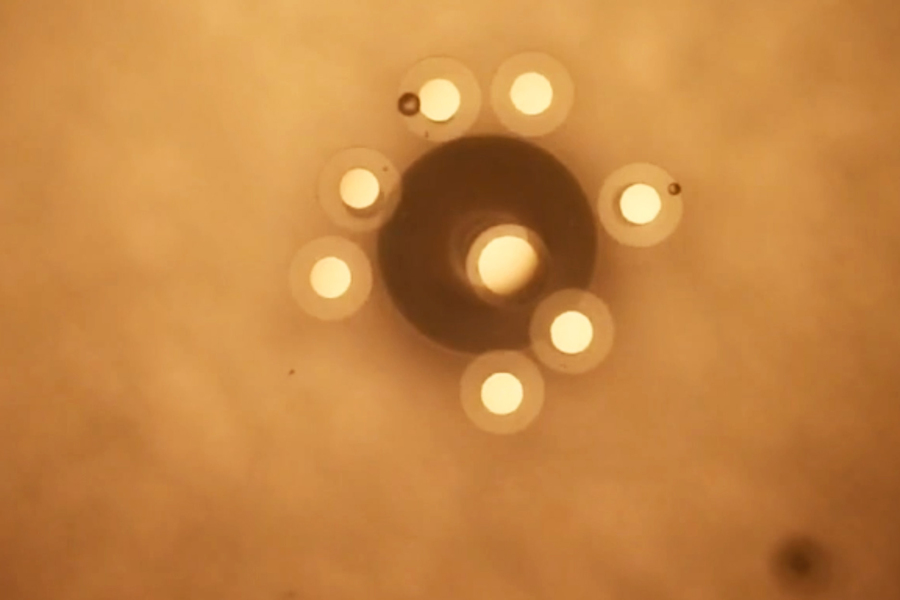
MIT engineers have created microparticles that collectively produce low-frequency oscillations, powering miniature robotic devices and unlocking new potentials in microrobotics through emergent behavior at the microscale.
Emergent Collective Behavior in Microparticles
Harnessing the concept of emergent behavior at the microscale, engineers from MIT have developed innovative microparticles capable of exhibiting intricate collective actions, akin to how ant colonies efficiently dig tunnels or gather food.
When these microparticles collaborate, they can create a low-frequency oscillating clock. This oscillation can be leveraged to power miniature robotic devices, showcasing a promising advancement in microrobotics.
“Beyond the fascinating physics, this behavior translates into an onboard oscillatory electrical signal, essential for microrobotic autonomy. Many electrical components rely on such oscillatory inputs,” explains Jingfan Yang, a recent MIT PhD graduate and co-author of the study.
Chemical Interactions Driving Oscillations
The particles that serve as the foundation for this new oscillator undergo a straightforward chemical reaction, facilitating interaction through the creation and bursting of tiny gas bubbles. Under optimal conditions, these interactions result in an oscillator that mimics the ticking of a clock, with beats occurring at intervals of several seconds.
“Our goal is to identify simple rules or features that can be encoded into basic microrobotic systems, enabling them to perform complex tasks collectively,” states Michael Strano, the Carbon P. Dubbs Professor of Chemical Engineering at MIT.
Strano leads the newly published research in Nature Communications, alongside co-authors Yang and Thomas Berrueta, a graduate student from Northwestern University.
Nature-Inspired Microrobotic Systems
Emergent behavior is observable throughout nature, where insect colonies, such as ants and bees, achieve remarkable feats that no single member could accomplish alone.
“Ants have tiny brains and can only perform basic cognitive tasks individually, but together they accomplish incredible things like foraging for food and constructing intricate tunnel systems,” Strano notes. “Understanding these principles allows us to engineer tiny systems capable of sophisticated operations.”
In this study, researchers aimed to design particles that could produce rhythmic movements or oscillations at low frequencies. Previously, creating low-frequency micro-oscillators required advanced electronics that were often costly and complex or specialized materials with intricate chemistries.
Microparticle Design and Oscillation Mechanism
The innovative microparticles designed in this study are small discs measuring as little as 100 microns in diameter. Composed of a polymer called SU-8, these discs feature a platinum patch that catalyzes the decomposition of hydrogen peroxide into water and oxygen.
When placed on the surface of a hydrogen peroxide droplet, these particles migrate to the top. At this liquid-air interface, they interact with other nearby particles. Each particle generates its own tiny oxygen bubble; when two bubbles collide, they burst, propelling the particles apart and initiating a continuous cycle.
“Individually, a particle remains stationary and unremarkable, but through collaboration, they can achieve something extraordinary and functional—an impressive feat at the microscale,” Yang remarks.
“Individually small components can join forces to perform complex tasks that are impossible alone—this principle is key to microrobotic innovation.”
Oscillator Synchronization and Applications
The study revealed that two particles could form a reliable oscillator; however, adding more particles disrupted the rhythm. Interestingly, introducing one particle with distinct characteristics allowed it to serve as a ‘leader,’ guiding the others back into sync.
This leader particle matches the size of its counterparts but has a slightly larger platinum patch that produces a bigger oxygen bubble, enabling it to centralize within the group and coordinate their oscillations. This method successfully created oscillators with groups of up to eleven particles.
Depending on the particle count, these oscillators exhibit frequencies ranging from 0.1 to 0.3 hertz—comparable to the low-frequency oscillators that regulate biological functions like walking and heartbeat.

Electrical Oscillations for Microrobotic Power
Moreover, researchers demonstrated that the rhythmic motion of these particles could generate an oscillating electric current. By substituting the platinum catalyst with a fuel cell made from platinum and ruthenium or gold, the mechanical oscillation modifies resistance across the fuel cell, transforming voltage into an oscillating current.
“Much like a dripping faucet, catalytic microdiscs at a liquid interface utilize chemical reactions to periodically produce and release gas bubbles. This study illustrates how such oscillatory dynamics can be harnessed for mechanical actuation and electrochemical signaling pertinent to microrobotics,” states Kyle Bishop, a professor of chemical engineering at Columbia University who was not part of the study.
Potential and Funding
- Creating oscillating currents enhances applications like powering miniature robots capable of locomotion.
- The MIT team showcased autonomous cyclic actuation driving microactuators previously operated by lasers.
- This breakthrough paves the way for controlling swarms of autonomous microrobots used as environmental sensors.
- The research was funded by the U.S. Army Research Office, Department of Energy, and National Science Foundation.
