



Newsroom

Innovative Nanosensors for Real-Time Detection of Plant Hormones in Agriculture
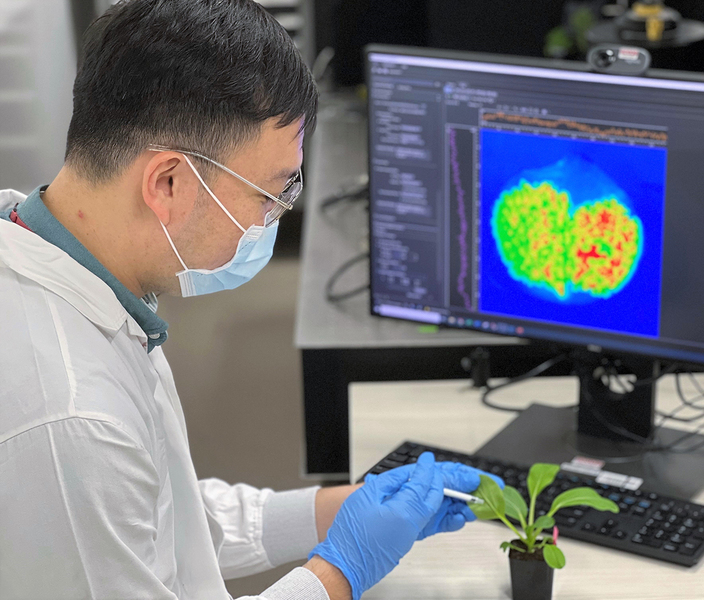
An innovative nanosensor developed through collaboration between SMART and Temasek Life Sciences Laboratory offers real-time, nondestructive detection of gibberellins, revolutionizing early-stage plant stress monitoring and precision agriculture.
Innovative Nanosensors for Plant Hormone Detection
A groundbreaking development in agricultural technology has emerged from a collaboration between researchers at the Singapore-MIT Alliance for Research and Technology (SMART) and Temasek Life Sciences Laboratory. They have created an innovative nanosensor capable of detecting and distinguishing gibberellins (GAs), a vital class of plant hormones that play a crucial role in growth and development.
These novel nanosensors are nondestructive and have been successfully tested on living plants, marking a significant advancement over traditional collection methods. With their application in early-stage plant stress monitoring, these sensors hold the potential to revolutionize agriculture and plant biotechnology, providing farmers engaged in precision agriculture with essential tools for optimizing crop yields.
The Role of Gibberellins and Historical Significance
The researchers designed near-infrared fluorescent carbon nanotube sensors to detect two specific plant hormones, GA3 and GA4, which are critical in regulating various growth processes. Historically, gibberellins have been influential in agricultural advancements, notably during the ‘green revolution’ of the 1960s, which helped avert famines worldwide. Continued research on gibberellins could lead to further breakthroughs that enhance food security.
The impact of climate change, such as increased soil salinity due to rising sea levels, poses challenges for agriculture by negatively affecting GA biosynthesis in plants. The newly developed nanosensors enable researchers to study GA dynamics under salinity stress early on, allowing farmers to intervene promptly when the sensors are applied in the field. This capability is foundational for effective early-stage stress detection.
Advanced Detection Techniques Over Traditional Methods
Typically, detecting GA3 and GA4 involves mass spectroscopy, a method that is both time-consuming and destructive. In contrast, the newly developed nanosensors offer high selectivity for GAs and provide real-time, in vivo monitoring of GA levels across a diverse array of plant species.
Published in the journal of materials science, the research highlights a breakthrough for early-stage plant stress detection and holds immense potential to advance both plant biotechnology and agriculture. This work builds on previous research focused on single-walled carbon nanotube-based nanosensors utilizing the corona phase molecular recognition (CoPhMoRe) platform.
“This nanosensor technology enables unprecedented early detection of plant stress signals, empowering farmers to protect crops before damage becomes visible.”
Application Across Plant Species and Stress Monitoring
Based on the CoPhMoRe technique pioneered by MIT Professor Michael Strano, these sensors can effectively monitor GA kinetics in various plant species, including Arabidopsis, lettuce, and basil. The sensors also track GA accumulation during lateral root emergence, emphasizing the importance of GAs in root system architecture. This innovation was made possible through the development of a new coupled Raman/near-infrared fluorimeter that simplifies the measurement process.
Using the reversible GA nanosensors, researchers identified increased GA levels in mutant plants with heightened GA20ox1 enzyme production and observed decreased GA levels under salinity stress. Notably, while lettuce growth was severely stunted after 10 days of salinity exposure, the nanosensors detected reduced GA levels within just six hours, showcasing their effectiveness as early indicators of stress.

Future Prospects and Industrial Applications
Professor Strano noted that their CoPhMoRe technique allows for creating nanoparticles resembling natural antibodies, enhancing stability compared to traditional options. The method has successfully yielded nanosensors for various plant signals, including hydrogen peroxide and heavy metal pollutants.
Mervin Chun-Yi Ang, an associate scientific director at SMART, emphasized that this advancement extends beyond mere stress detection; it introduces hardware innovation through a coupled Raman/NIR fluorimeter that enables self-referencing of sensor fluorescence. The potential integration of these sensors with low-cost electronics and microneedle interfaces could significantly alter how industries manage plant stress in food crops.
The versatility of these nanosensors opens doors for numerous industrial applications. Daisuke Urano from Temasek Life Sciences Laboratory explained that GAs regulate various plant development processes and can be utilized by growers as plant growth regulators. This novel technology could facilitate early-stage stress monitoring and enhance growers’ ability to track GA metabolism in crops.
This research was conducted collaboratively by SMART and MIT with support from Singapore’s National Research Foundation under its Campus for Research Excellence And Technological Enterprise (CREATE) program. The DiSTAP initiative aims to tackle significant challenges in global food production through innovative analytical and genetic technologies.
