



Newsroom

Innovative Sound-Reducing Silk Fabric for Enhanced Acoustic Comfort
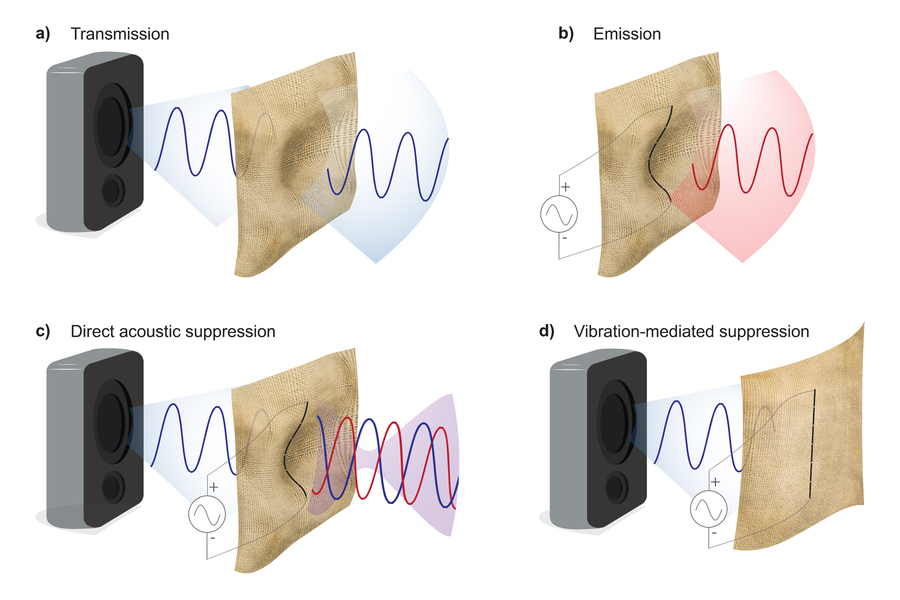
In our increasingly noisy world, unwanted sounds permeate our daily lives—from traffic noise to loud televisions and bustling workplaces. This persistent issue has prompted a collaboration among researchers from MIT and other institutions to develop an innovative sound-suppressing silk fabric designed to create quieter environments.
Revolutionizing Noise Control with Advanced Fabric Technology
This groundbreaking fabric, remarkably thin—akin to a human hair—incorporates a specialized fiber that vibrates in response to an applied voltage. The researchers harness these vibrations to mitigate sound through two distinct methods.
- The first method involves the vibrating fabric producing sound waves that counteract unwanted noise, similar to how noise-canceling headphones function. While effective in smaller spaces, this technique can be limited in larger areas such as rooms or airplanes.
- In a more unexpected approach, the fabric remains stationary to suppress vibrations that are crucial for sound transmission. This effectively reduces noise passing through the fabric, significantly lowering volume levels in larger spaces such as living rooms or vehicles.
Practical Applications and Expert Insights
By utilizing everyday materials like silk, canvas, and muslin, the researchers have created practical noise-suppressing fabrics that can be easily integrated into real-world environments. For instance, this fabric could be used to create dividers in open office spaces or thin walls that significantly block sound.
“Noise is much easier to create than silence. To block noise, we often rely on thick walls. Grace’s work introduces a novel method for creating quiet spaces using just a thin sheet of fabric,” explains Yoel Fink, a professor at MIT.
Technical Innovations Behind the Fabric
The development of this sound-suppressing silk builds on previous work in which researchers created fabric microphones by embedding piezoelectric fibers within textiles. These materials generate electrical signals when deformed, allowing them to capture sound.
In this new research, the concept was inverted to produce a fabric loudspeaker capable of canceling sound waves. When an electrical signal is applied to the piezoelectric fiber, it vibrates and produces sound, demonstrated by playing Bach’s ‘Air’ on a silk sheet.
To achieve direct sound suppression, the researchers utilize the silk fabric loudspeaker to emit sound waves that destructively interfere with unwanted noise. This method allows for significant noise reduction across larger areas.

Experimental Results and Collaborative Achievements
The researchers discovered that when the silk fabric is placed against a shared wall, it can dramatically reduce transmitted sound levels. In tests, the fabric achieved a reduction of up to 65 decibels and could suppress sound transmission by as much as 75%.
These advancements were made possible through collaboration with various institutions, including design students who aided in fabric construction and scientists who conducted simulations.
Future Directions for Enhanced Noise Suppression
Looking ahead, the team aims to explore ways to enhance the fabric’s ability to block multiple frequencies of sound, which may require complex signal processing and additional electronic components.
Further investigations will focus on optimizing the fabric’s architecture—examining factors like the arrangement of piezoelectric fibers and variations in applied voltages to enhance performance.
“There are numerous variables we can adjust to maximize the effectiveness of this sound-suppressing fabric. We want to inspire new ways of controlling structural vibrations for noise reduction. This is just the beginning,” concludes Yang.
This research is supported by funding from the National Science Foundation (NSF), Army Research Office (ARO), Defense Threat Reduction Agency (DTRA), and Wisconsin Alumni Research Foundation.
