



Newsroom

MIT Innovators Honored with National Medals for Scientific Excellence and Technological Advancements
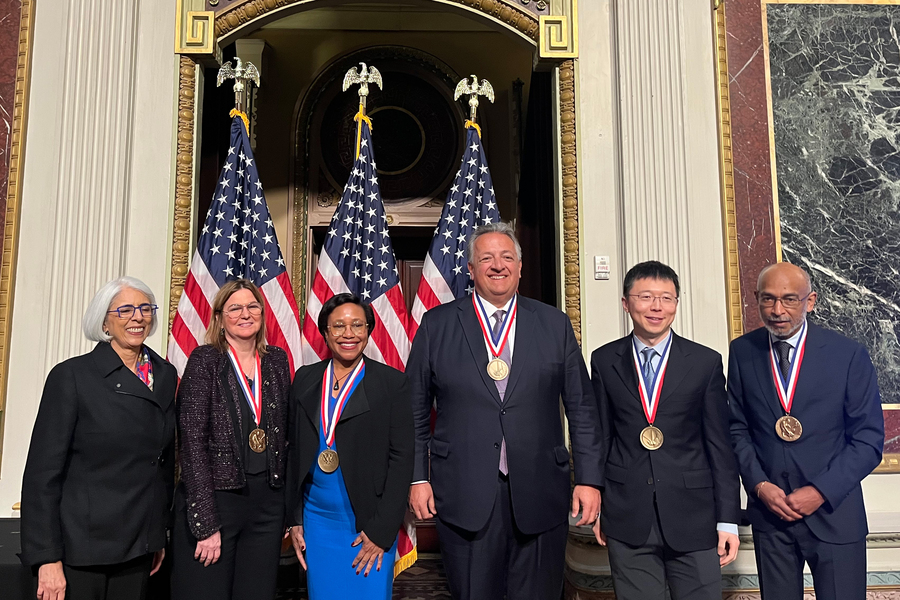
The White House recently announced that four faculty members from MIT have been honored among 23 distinguished researchers with the nation’s highest awards for scientific and innovative achievements.
Honorees and Their Achievements
Angela Belcher and Emery Brown were each awarded the National Medal of Science, while Paula Hammond and Feng Zhang received the National Medal of Technology and Innovation.
Angela Belcher, a prominent figure in Biological Engineering and Materials Science, was recognized for her innovative work in developing advanced materials for applications such as solar cells, batteries, and medical imaging.
Emery Brown, known for his contributions to Medical Engineering and Computational Neuroscience, was celebrated for his groundbreaking research revealing the effects of anesthesia on brain function.
Paula Hammond, an esteemed MIT Institute Professor, received accolades for her pioneering techniques in assembling thin films for drug delivery and wound healing.
Feng Zhang, a leading researcher in Neuroscience, was acknowledged for his development of molecular tools, including the CRISPR genome-editing system, which holds promise for disease diagnosis and treatment.
Alumni Recognition and Award Highlights
Additionally, two MIT alumni were honored: R. Lawrence ‘Larry’ Edwards received a National Medal of Science for his work in geochemistry, and Noubar Afeyan accepted a National Medal of Technology and Innovation for his contributions to biotechnology through companies like Moderna.
This year’s awards included 14 recipients of the National Medal of Science and nine individual awardees of the National Medal of Technology and Innovation, highlighting nearly 100 MIT affiliates who have achieved this recognition over the years.
Impact on Science and Technology
“Brown’s research is revolutionizing how anesthesia is monitored during surgical procedures.”
Dean Nergis Mavalvala emphasized Brown’s pivotal role in bridging neuroscience and anesthesia, noting that his research is revolutionizing how anesthesia is monitored during surgical procedures.
Hammond and Belcher have made significant contributions to nanotechnology and nanomedicine. Dean Anantha Chandrakasan praised their innovative approaches that harness nature’s processes to improve patient outcomes across various fields.
Innovations Driving Progress
Belcher’s journey began at MIT in 2002, where she has since focused on utilizing biological systems to create materials with technological relevance, such as using engineered viruses to produce nanoscale scaffolds.
Her collaborative efforts led to advancements in imaging technologies used during cancer surgeries, enabling real-time detection of tumor spread.
Brown’s research has advanced our understanding of how anesthesia alters brain states. He utilizes EEG technology to monitor patients’ consciousness levels, aiming for more precise control over anesthesia delivery.
Hammond’s innovative layer-by-layer assembly technique has revolutionized drug delivery systems, allowing for targeted release of therapies directly to cancer cells.
Zhang’s contributions to CRISPR technology have opened new avenues in genetic research, enhancing our ability to edit genes for therapeutic purposes.
National Recognition Significance
The National Medal of Science and the National Medal of Technology and Innovation recognize individuals who have made significant impacts on science, engineering, and America’s technological landscape.
