



Newsroom

MIT Physicists Recognized with Prestigious Awards for Groundbreaking Research
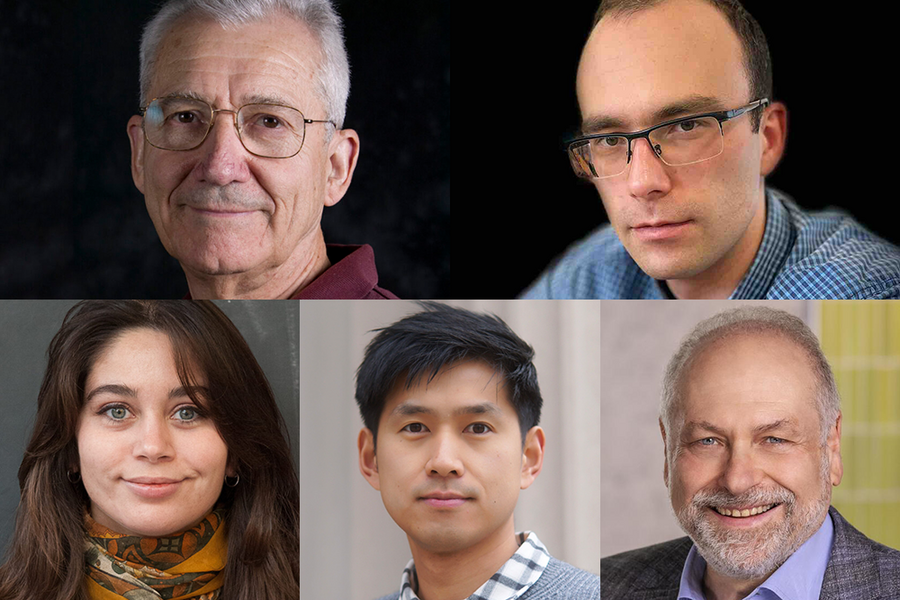
Recently, five members of the MIT community were recognized by the American Physical Society (APS) for their significant contributions to the field of physics. The honorees include Professor Wit Busza, Instructor Karol Bacik, postdoctoral researchers Cari Cesarotti and Chao Li, and alumnus Pablo Gaston Debenedetti.
Honoring Pioneers in Nuclear and Particle Physics
Wit Busza, an esteemed professor emeritus in physics and a key figure at the Laboratory for Nuclear Science, received the Tom W. Bonner Prize in Nuclear Physics. This prestigious award acknowledges his pioneering research in multi-particle production during proton-nucleus and nucleus-nucleus collisions, particularly highlighting his discovery of participant scaling and his leadership in the PHOBOS experiment.
This award celebrates exceptional experimental research that significantly advances nuclear physics. In high-energy collisions, such as those involving lead nuclei, an astonishing array of particles emerges, exemplifying the transformation of energy into mass. For instance, over 10,000 particles including protons, neutrons, and mesons can be observed emerging from these minuscule collision zones.
“The volume where these reactions occur is comparable to just a hundred particles. What remains fascinating is the ultra-hot and dense matter generated during these collisions, believed to be the quark-gluon plasma that formed shortly after the Big Bang.” – Wit Busza
Notably, Busza’s impactful experiments at Fermilab led to the discovery of participant scaling and provided essential data for estimating energy density in future collider projects like the Relativistic Heavy Ion Collider (RHIC). He is also credited with spearheading the PHOBOS experiment, contributing to the discovery of a strongly interacting quantum chromodynamics liquid.
Breakthroughs in Fluid Dynamics and Mathematical Modeling
The 2023 Andreas Acrivos Dissertation Award in Fluid Dynamics was awarded to Karol Bacik, an applied mathematics instructor, for his innovative study on dune dynamics using laboratory experiments and mathematical modeling. His research has provided valuable insights into the interaction between sediment dynamics and fluid mechanics.
Bacik completed his PhD at the University of Cambridge in 2021 and continued his research at the University of Bath until 2023. His award lecture is scheduled for the upcoming APS Division of Fluid Dynamics Annual Meeting on November 21.
Advances in Theoretical Particle Physics
Postdoctoral researcher Cari Cesarotti from the Center for Theoretical Physics was honored with the 2023 J.J. and Noriko Sakurai Dissertation Award in Theoretical Particle Physics. Her research focuses on collider signals indicative of physics beyond the Standard Model, including novel methods for distinguishing complex interactions in future muon colliders.
Cesarotti’s work aims to explore new physics scenarios through innovative observables and robust experimental approaches. She earned her undergraduate degree from Cornell University in 2017 and completed her dissertation at Harvard University in 2022.
Innovations in Beam Physics and Quantum Photonics
Chao Li, a postdoc at the Research Laboratory of Electronics (RLE), received the 2023 Outstanding Doctoral Thesis Research in Beam Physics Award for his groundbreaking contributions to microfabricated atomic beam technology and chip-scale techniques enabling precise neutral atom delivery.
At MIT RLE’s Quantum Photonics and AI Group, Li is engaged in advanced studies of photonic integrated circuits aimed at controlling various types of qubits efficiently. He holds a bachelor’s degree from Jilin University (2016) and a PhD from Georgia Tech (2022), both in physics.
Computational Physics Excellence
Lastly, Pablo Gaston Debenedetti, a distinguished alumnus from the MIT Department of Chemical Engineering and current dean for research at Princeton University, received the 2023 Aneesur Rahman Prize for Computational Physics. His award recognizes his influential research on supercooled liquids, glasses, and water through pioneering simulations.
Debenedetti’s research encompasses various topics including supercooled water behavior, protein thermodynamics, and hydrophobicity. His notable findings include demonstrating the existence of a liquid-liquid transition in water models and elucidating the connection between structural order and unique properties of water.
