



Newsroom

MIT’s Doya Team: Pioneering Indigenous Representation in Aerospace Engineering
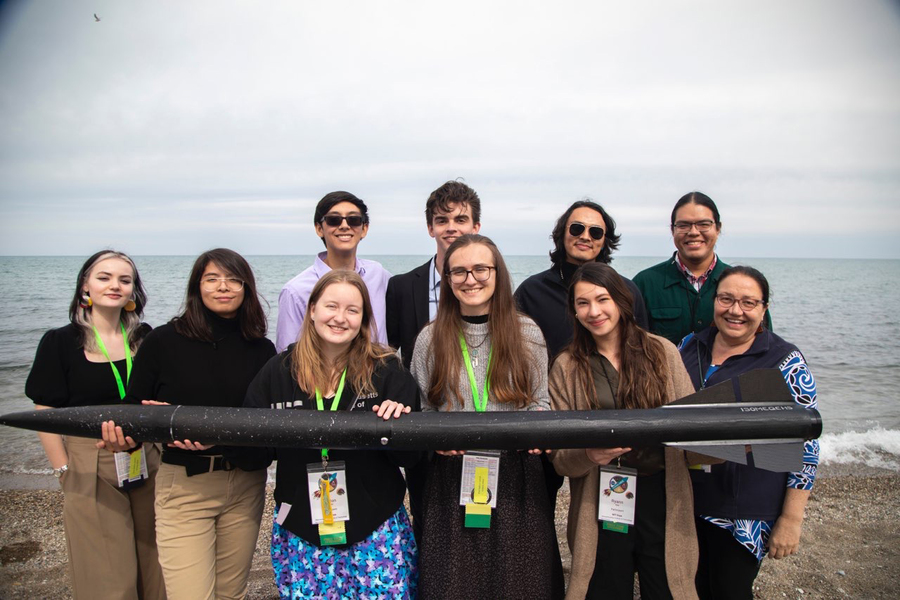
Earlier this year, a team from MIT participated in the 2023 First Nations Launch, an international challenge organized by the Wisconsin Space Grant Consortium under NASA’s Artemis initiative. This event highlights Indigenous representation and scientific exploration in aerospace engineering through rocketry, marking MIT’s inaugural entry into this 15-year-old competition.
A Unique Indigenous Rocketry Initiative
Over two semesters, a dedicated team composed entirely of Indigenous students, including both undergraduate and graduate members, collaborated to design, construct, test, document, present, and launch an approximately 8-foot rocket built entirely from scratch at MIT. This year’s challenge specifically required the team to innovate carbon fiber and fiberglass composite layup techniques to ensure that the airframe was lightweight while maintaining its structural integrity.
“I never thought I’d join a rocket team until I learned about this all-Indigenous build team. I saw it as a great opportunity to connect with my community,” shares Peyton Meader, a member of the Passamaquoddy Tribe and the team’s safety/avionics lead.
Team Doya’s Success and Cultural Roots
The team adopted the name Doya (ᏙᏯ), which translates to “beaver” in Cherokee, as suggested by team member Hailey Polson, a Cherokee citizen. At the recent First Nations Launch event, MIT Doya successfully launched their rocket to an impressive height of 1,290 meters, earning the second-place grand prize and being recognized as the rookie team of the year.
“Embarking on a journey to the stars is deeply rooted in Indigenous culture. It resonates with our stories and traditions. Our aim is to visit Father Sky respectfully, seeking knowledge and sharing our hopes. Many Indigenous people are naturally drawn to aerospace for these reasons,” explains Nicole McGaa, team captain for 2022-23 and now serving as the project’s manager. “Traditional rocketry often overlooks this aspect. Indigenous methodologies in aerospace engineering embrace a different perspective that values wonder and inspiration as integral to our endeavors.”
“Embarking on a journey to the stars is deeply rooted in Indigenous culture. It resonates with our stories and traditions.”
Preparing for the Next Challenge
The Doya team is currently preparing for the 2024 First Nations Launch Challenge in Wisconsin. All members from last year have returned, along with two enthusiastic first-year students, with sophomore Hailey Polson stepping up as the captain.
The team receives guidance from Jeffrey Hoffman, MIT professor of aeronautics and astronautics, alongside Nina Lytton, spiritual advisor for the Indigenous community. Additionally, Aaron Ashley ’16, president of Indigenous Alumni of MIT and First Nations Launch mentor, offers support. The initiative is sponsored by MIT’s chapter of the American Indian Science and Engineering Society, the Edgerton Center, and the Massachusetts Space Grant Consortium.
Technical Innovation and Community Outreach
This year’s First Nations Launch challenge requires teams to design, build, and test a rocket along with a special payload that will be deployed at apogee. This payload must feature its own parachute system and include a drone designed and built by the team, which will be piloted from an altitude of 400 feet to a designated landing area.
In addition to tackling the technical challenges of this year’s competition, the team aims to enhance outreach efforts led by AeroAstro PhD student Alvin Harvey. They are organizing events to engage local Indigenous youth with STEM principles, particularly in rocketry, while connecting these concepts to traditional knowledge. The objective is to introduce Indigenous youth to higher education opportunities in STEM fields without compromising their cultural identity or community ties.
Get Involved
Members of the MIT community interested in joining the team or participating in outreach initiatives can reach out via fnl-exec@mit.edu.
