



Newsroom

South Korea’s President Yoon Explores Biomedical Innovation at MIT
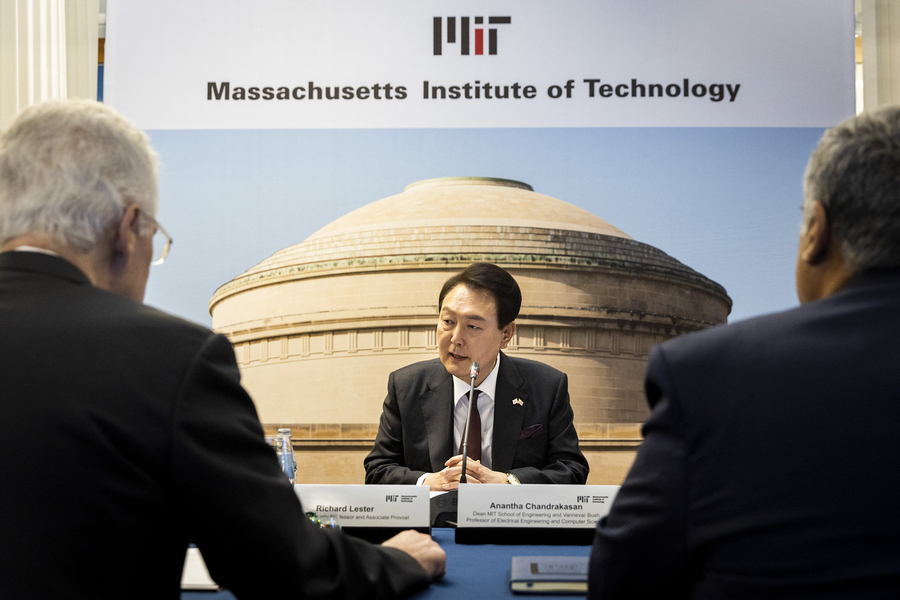
During a recent visit to MIT, South Korean President Yoon Suk Yeol engaged in a productive roundtable discussion focused on biomedical research and the cultivation of technology-driven innovation clusters. This meeting included esteemed leaders and faculty members from the institute.
Building a Biomedical Innovation Cluster
In his address, President Yoon highlighted South Korea’s robust educational institutions, advanced hospitals, and state-of-the-art research facilities. He emphasized the need for the country to foster a biomedical innovation cluster akin to the renowned Kendall Square in Cambridge, Massachusetts. This area is celebrated for its vibrant ecosystem where established companies, startups, academic research, and agile investment converge to form a global hub for bioscience innovation.
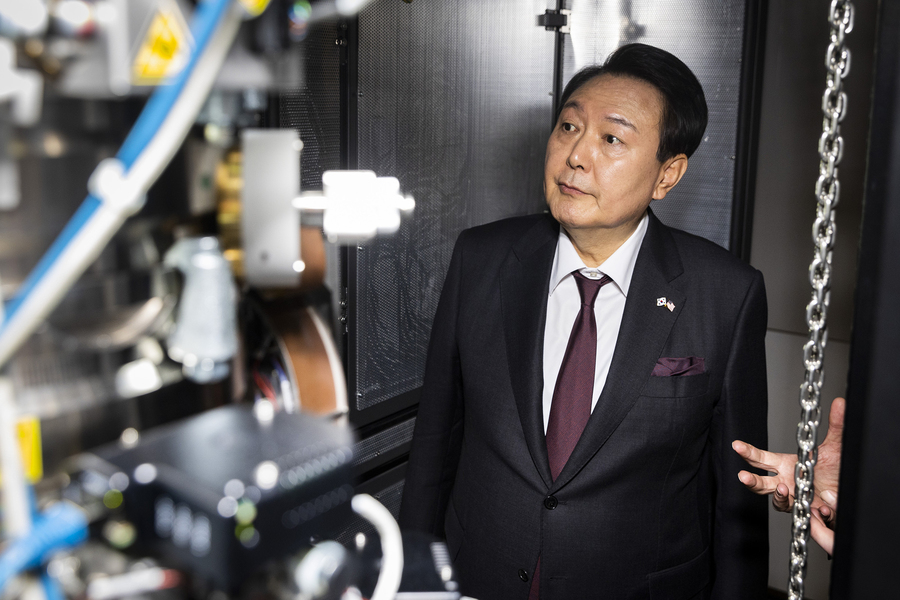
“We require innovation clusters that amplify our collective capabilities,” Yoon remarked during the event held at MIT.nano, where he also toured the cutting-edge Cryo-Electron Microscopy Facility. This facility allows for near-atomic evaluation of molecular structures and other organic materials.
Insights from MIT Faculty
The president’s agenda included insights from MIT faculty members, followed by an interactive discussion. “I hope the Republic of Korea can learn from your exemplary initiatives,” Yoon expressed, acknowledging that significant advancements would take time.
Yoon’s visit was part of a six-day state trip to the U.S., featuring a formal state dinner hosted by President Joe Biden, aimed at reinforcing the enduring 70-year alliance between the two nations, addressing both security and economic matters.
The roundtable was facilitated by Richard Lester, Associate Provost for International Activities, and Anantha Chandrakasan, Dean of the MIT School of Engineering. They welcomed Yoon to MIT, highlighting the honor of hosting such an esteemed leader.
In his opening remarks, Yoon underscored the necessity of sustained investment in science and technology as a vital objective for his administration. Six MIT professors shared their insights on biotechnology and strategies for enhancing innovation.
Advances in Biotechnology and AI
Robert Langer, a prominent figure in biotech research, described the successful model of research-driven biotech startups he has cultivated over recent decades, which includes Moderna, known for its COVID-19 vaccine. Langer noted the positive transformation of the area surrounding MIT and acknowledged the growing interest in biotechnology within South Korea.
Dina Katabi discussed the potential of AI in diagnosing serious conditions like Parkinson’s disease by analyzing brain activity data. She emphasized that such innovations can revolutionize medical practice.
>James Collins elaborated on how AI is being leveraged to develop new antibiotics in response to rising antibiotic resistance. He highlighted that without new advancements, drug-resistant illnesses could pose a significant threat to global health by 2050.
“We require innovation clusters that amplify our collective capabilities.” — President Yoon Suk Yeol
Fostering Talent and Ecosystem Growth
The MIT faculty also addressed various research and development topics in response to inquiries from the South Korean delegation. Collin Stultz discussed the importance of nurturing talent in the biomedical sector, emphasizing the need for scholars to possess both technical skills and an understanding of critical biological questions.
Kwanghun Chung shared insights on creating a thriving innovation ecosystem, likening it to natural seeding processes that foster extensive growth. This perspective resonated with Yoon, who acknowledged that such growth takes time.
Giovanni Traverso showcased innovative small drug-delivery systems developed at MIT, illustrating how these devices effectively target their intended sites in the body.
South Korea’s Scientific Leadership
Alongside President Yoon were key figures from South Korea’s scientific community, including Lee Jong Ho, Minister of Science and ICT; Choi Sang Mok, Senior Secretary for Economic Affairs; and Kim Young Tae, President of Seoul National University Hospital. Lee expressed that the visit provided meaningful insights into current trends and strategic developments.
Elected in March 2022, President Yoon has a rich background in law and public service, having served as South Korea’s prosecutor general prior to his presidency.
